Payment gateway vs. payment aggregator: what’s the difference?
Baiyar is positioned as a payment aggregator: one merchant integration for payment methods supported by connected providers. Learn how the flow works and where provider responsibilities begin.
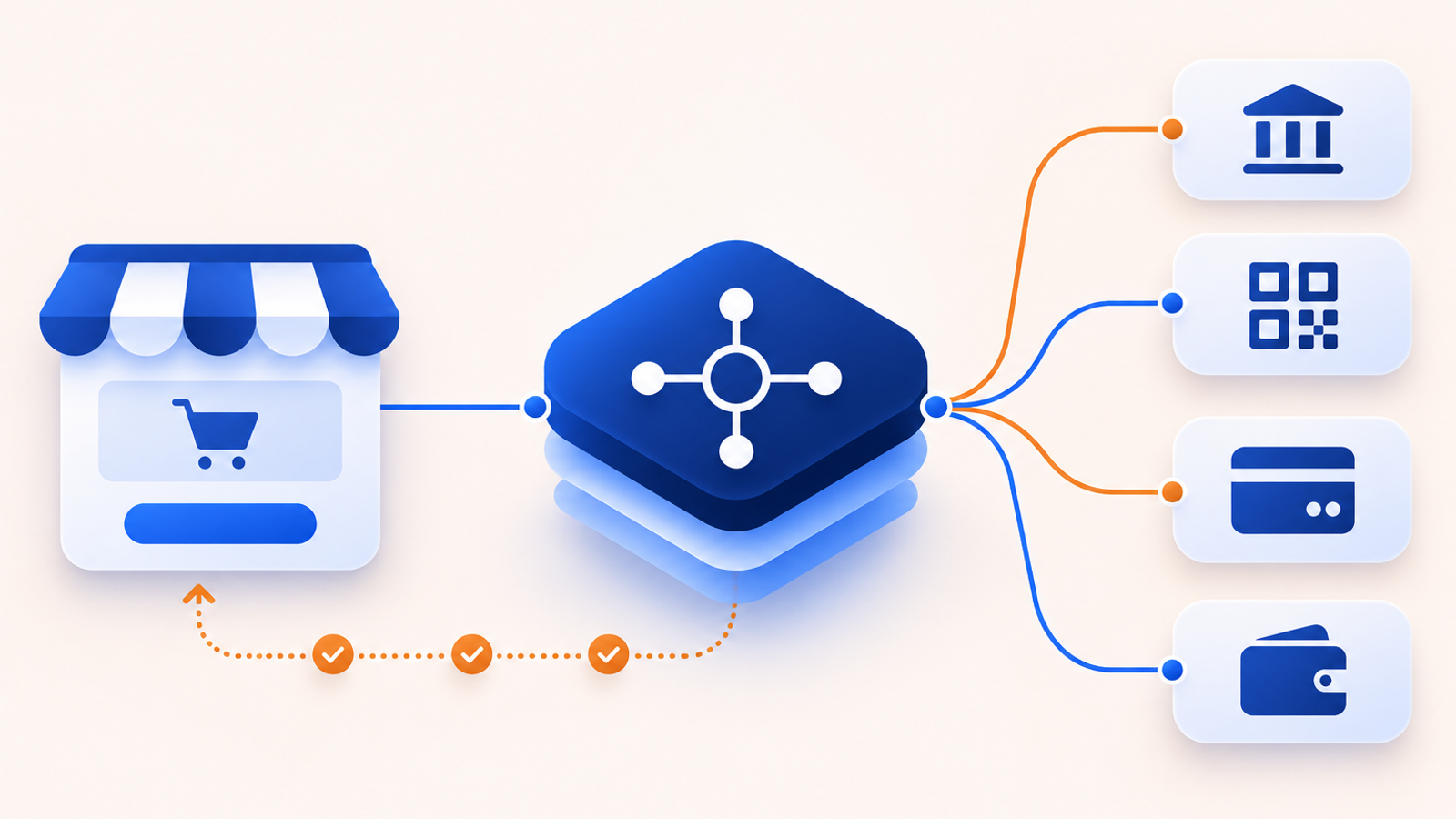
A payment gateway connects a checkout to a provider and routes payment requests. A payment aggregator gives merchants one integration to access services from multiple connected providers. Baiyar follows this model: merchants create payment links or use hosted checkout, customers choose a method enabled for that merchant, and Baiyar routes the request to a supported provider. The provider processes the payment and returns its status to Baiyar.
A payment gateway routes payment requests
A gateway connects a merchant’s checkout to payment processing. The customer chooses a method, the checkout sends transaction details to the gateway, and the gateway routes the request to the provider that supports that method. A result then returns to the merchant’s system.
- The checkout creates a payment request with an amount and transaction reference.
- The gateway sends the request to a payment provider or network.
- The provider returns a status, which the gateway can show in a dashboard or send through an API or webhook.
Some gateways also provide a hosted checkout, payment-method selection, or transaction reporting. Depending on the arrangement, acquiring and the transfer of funds may be handled by a different provider.
A payment aggregator groups merchant operations
An aggregator usually offers one integration for multiple merchants or submerchants. It may coordinate merchant onboarding, assign merchant identifiers, combine transaction reporting, and route payments through one or more providers. Some models also coordinate settlement to each merchant.
Those functions vary by service. The word “aggregator” alone does not tell you who holds the merchant relationship, where funds move, or who is responsible for a delay, refund, or dispute.
Why the terms overlap
A gateway can take on aggregator functions. The names are not mutually exclusive: one product may route payment data and also manage onboarding or settlement operations.
Bank Indonesia describes a payment gateway as an electronic service that lets merchants process payments using cards, electronic money, or a proprietary channel. In its 2025 QRIS rule, Bank Indonesia defines a Merchant Aggregator more narrowly as a non-PJP party that acquires QRIS merchants and forwards QRIS transaction funds through cooperation with a PJP. That QRIS definition should not be treated as a universal label for every aggregator product.
Bank Indonesia also groups payment-service-provider activities by what the provider does, including payment initiation and/or acquiring services. For a real service, check the activities and partners involved. A product name by itself does not establish its regulatory role.
Compare responsibilities before choosing
Ask the provider to walk through one transaction from checkout to the merchant’s account. Then confirm:
- Who signs the merchant agreement and completes merchant onboarding?
- Which provider processes each payment method, and what merchant identifier appears in the records?
- Who sends settlement, on what schedule, and how are fees or adjustments shown?
- Who handles refunds, disputes, failed payments, and settlement delays?
- Can you export transaction and settlement records, or access them through an API?
- What licensing and compliance responsibilities apply to each party in the flow?
A gateway may fit a business that already has direct provider relationships and needs a checkout integration. An aggregator may reduce the number of integrations or onboarding steps when a business manages several merchants or payment channels. Compare the actual contract, fee schedule, fund flow, and support process. Neither label guarantees lower costs or faster settlement.
References: Bank Indonesia: Payment Gateway; PBI 23/6/PBI/2021 on Payment Service Providers; PADG 3/2025 on QRIS.